


Key Takeaways:
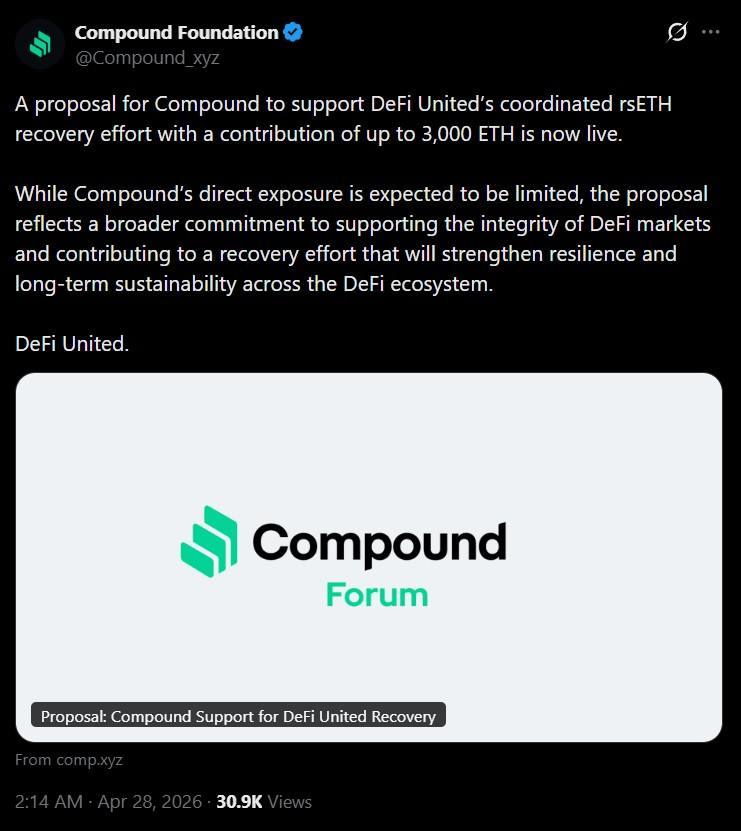
- Compound proposed contributing between 1,900 and 3,000 ETH worth up to $6.9 million to Defi United’s rsETH recovery on April 28.
- DeFi United’s 14-protocol coalition has secured over $161 million in ETH commitments to restore rsETH backing after the April 18 exploit.
- Consensys and Joe Lubin committed 30,000 ETH to Defi United, with Lubin calling the initiative “a broad, coordinated response to protect users.”
Compound Conditions for Participation
The proposal, submitted to Compound’s governance forum, seeks approval in principle from the Compound community. The final contribution amount within the 1,900 to 3,000 ETH range will be determined by the Compound Governance Working Group alongside Gauntlet, security service providers, and the Compound Foundation.
Defi United’s technical implementation plan targets the recovery of approximately 16,776 ETH from exploiter positions on Compound, in parallel with a 13,000 ETH recovery from Aave.
The proposal sets explicit conditions for releasing funds. Full restoration of rsETH collateral is required, along with equal treatment of all affected parties and a clear, transparent execution plan with regular governance updates. Roughly 1,857 ETH of the total commitment is contingent on successfully recovering the attacker’s active position. The DAO retains the ability to scale back or withdraw support if those conditions are not met.
A $161 Million Industry Response
Compound’s proposal joins a coalition that has assembled an unprecedented level of cross-protocol coordination. Consensys and Ethereum co-founder Joe Lubin committed 30,000 ETH to the initiative, providing immediate liquidity for governance processes without forcing rushed decisions.
Aave contributed 25,000 ETH, with the platform’s founder Stani Kulechov adding a personal commitment of 5,000 ETH. Mantle provided a 30,000 ETH credit facility, while Lido committed up to 2,500 stETH.
On the development, Lubin said: “ Defi United is exactly that, a broad, coordinated response to protect users and strengthen the infrastructure.” The Avalanche Foundation, also backing the effort, framed the moment in broader terms, noting that even though the Defi ecosystem was undergoing a stress-test in public, this time it was doing so “with transparent books and real accountability.”
The coalition marks one of the largest coordinated recovery efforts in decentralized finance ( Defi) history, with governance votes still pending across several participating protocols.