

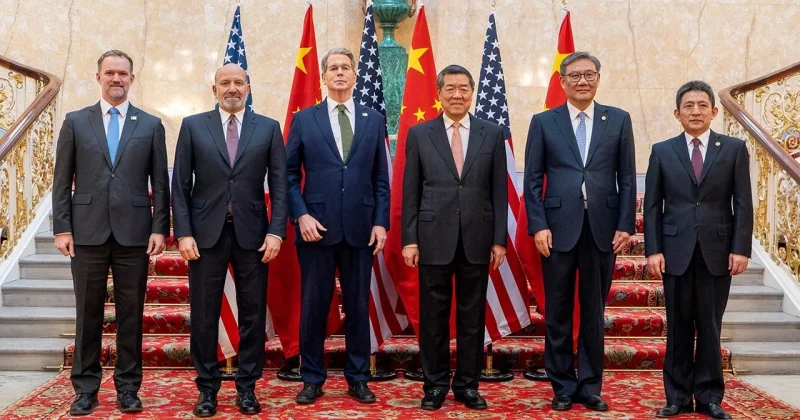
The world’s two largest economies just agreed to stop punching each other in the wallet. China announced it has reached a tentative agreement with the United States on tariff reductions and trade cooperation, a development that could reshape global risk sentiment and, by extension, the appetite for digital assets.
The arrangement, formalized as the “Kuala Lumpur Joint Arrangement,” includes reciprocal tariff reductions, suspended retaliatory measures, and a commitment from Beijing to lift export controls on critical minerals. For crypto investors, the signal isn’t subtle: when the US and China de-escalate, money tends to flow toward riskier assets. Bitcoin and Ethereum have historically benefited from exactly this kind of macro thaw.
What’s actually in the deal
The agreement covers several fronts, but the headline number is a 10 percentage point reduction in US tariffs on Chinese imports. That cut is specifically targeted at goods linked to fentanyl flows, tying trade policy to the ongoing opioid crisis in a way that gives both sides political cover.
On China’s side, Beijing has agreed to suspend retaliatory tariffs and non-tariff measures against US goods that date back to March 2025. The result adjusts China’s tariff rate on US exports to approximately 21.9%, a meaningful step down from the escalatory levels that had been rattling supply chains for months.
Here’s where it gets interesting for the tech and crypto world. China has also pledged to eliminate export controls on rare earth elements and critical minerals. These materials are the unglamorous backbone of everything from semiconductor fabrication to the hardware that powers blockchain infrastructure. Restricted access to them had been quietly choking supply chains across the technology sector.
Beijing also committed to stopping retaliation against US semiconductor firms and easing trade restrictions that had been hammering the chip sector. In English: the two countries are agreeing to stop weaponizing the components that modern technology literally cannot function without.
Why crypto markets are paying attention
Look, a tariff agreement between the US and China isn’t a crypto event in any direct sense. Nobody is trading rare earth futures on Uniswap. But the indirect effects are substantial, and dismissing them would be a mistake.
Trade wars create uncertainty. Uncertainty makes institutional investors retreat to cash and treasuries. When that uncertainty lifts, capital rotates back into risk assets. Crypto sits firmly in the “risk asset” category, whether Bitcoin maximalists like it or not.
The pattern has played out repeatedly. Every major de-escalation in US-China trade tensions over the past several years has coincided with improved performance in both equities and digital assets. The mechanism isn’t mysterious: when global supply chains look stable, companies invest more, economic forecasts improve, and investors feel comfortable reaching for higher returns.
The critical minerals component adds another layer. Semiconductor supply chains directly affect the hardware used in Bitcoin mining, AI computation, and the broader infrastructure supporting blockchain networks. Lifting export controls on these materials could ease cost pressures for mining operations that depend on specialized chips manufactured with rare earth inputs.
There’s also the currency angle. Trade tensions between the US and China have historically driven volatility in the yuan, which in turn has sometimes pushed Chinese capital toward Bitcoin as a hedge. A more stable trade relationship could reduce that particular flow, but the net effect of improved global risk sentiment likely more than compensates.
The bigger picture
This agreement didn’t materialize overnight. US-China trade relations have been deteriorating in waves since 2018, with tariffs, counter-tariffs, and export controls escalating through multiple administrations. The measures suspended under this deal trace back to a particularly aggressive round of retaliatory actions from March 2025, when both sides appeared to be settling in for a prolonged economic standoff.
The fact that the arrangement was formalized in Kuala Lumpur rather than Washington or Beijing is itself notable. Neutral ground suggests both sides wanted to signal cooperation rather than capitulation. Neither government can afford to look like it blinked, which is why the deal is structured as reciprocal rather than one-sided.
For the semiconductor industry specifically, China’s pledge to stop retaliating against US chip firms addresses one of the most contentious flashpoints in the relationship. US restrictions on advanced chip exports to China had triggered a cycle of counter-measures that was starting to fragment the global semiconductor supply chain into competing blocs.
What investors should actually watch
The word “tentative” is doing a lot of heavy lifting here. Trade agreements between the US and China have a history of being announced with fanfare and then quietly eroding as implementation details prove difficult. The Phase One trade deal from 2020 is the cautionary tale: ambitious targets, underwhelming follow-through.
Investors should watch whether China actually lifts those critical mineral export controls in practice, not just on paper. Rare earth processing is concentrated in China to a degree that gives Beijing enormous leverage, and relinquishing that leverage permanently seems unlikely regardless of what any agreement says.
The 21.9% tariff rate on US exports to China, while lower than recent peaks, is still meaningfully elevated by historical standards. This is a de-escalation, not a return to free trade. The structural competition between the two economies hasn’t gone away.
For crypto specifically, the key metric to monitor is whether this agreement translates into sustained improvement in global risk appetite. Bitcoin has been increasingly correlated with macro sentiment, and a genuine trade detente could provide tailwinds through the rest of the year. But if implementation stalls or new friction points emerge, those tailwinds reverse quickly.
The semiconductor supply chain developments deserve particular scrutiny from anyone invested in proof-of-work mining operations or the broader blockchain infrastructure sector. Cheaper, more accessible chip manufacturing inputs would be structurally positive for mining economics. Whether that actually materializes depends entirely on whether Beijing follows through on the critical minerals commitments, something the market should price cautiously until there’s evidence of real action.