

Key Takeaways
- Ethereum researchers propose cutting expected transaction finality from 16 minutes to 4 minutes.
- Ethereum’s Decoupled Consensus design separates block selection from finality voting.
- The proposal targets stronger security but has no approved implementation date.
Ethereum Researchers Propose Cutting Finality Time by 75%
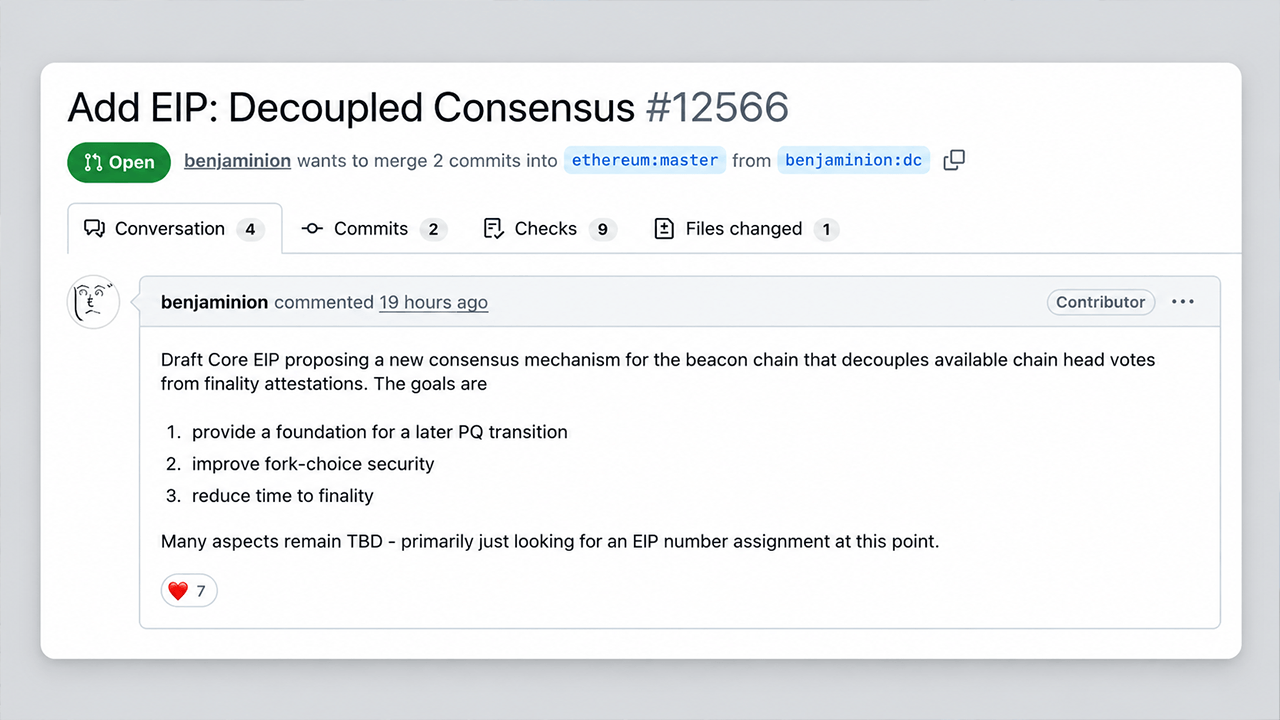
Ethereum developers have proposed a fundamental overhaul of the blockchain’s consensus system, targeting a fourfold reduction in the time it takes transactions to become final. The Decoupled Consensus proposal, submitted Oct. 21, 2026, aims to shrink expected finality from approximately 16 minutes to just 4 minutes.
Beyond faster settlement, the redesign promises stronger protection against network manipulation and a foundation for future quantum-resistant security. However, the proposal remains unfinished, with no scheduled activation.
Ethereum’s 16-Minute Wait Faces a Major Overhaul
The proposal, identified as EIP-8453, was submitted by Ben Edgington and four fellow researchers. It would separate two responsibilities currently performed together by Ethereum validators: choosing which blocks the network follows and determining when transactions become irreversible under normal operating conditions.
Smaller committees, potentially involving approximately 512 validators per slot, would handle block selection. The entire validator network would continue voting on finality, requiring approval from at least two-thirds of active staked ether (ETH). The separation would allow finality to progress independently of block production, potentially reducing delays without abandoning Ethereum’s existing security principles.
Faster Finality Means Less Money Sitting Idle
The financial implications are substantial. Consider a cross-chain service advancing $1 million hourly while awaiting Ethereum settlement. At 16-minute finality, approximately $267,000 remains tied up. Reducing that wait to four minutes drops the figure to roughly $67,000, freeing approximately $200,000 in working capital.
The proposed changes also address attacks involving delayed validator votes and blockchain reorganizations. Temporary voting locks and expiring votes would make certain manipulation strategies more difficult.
Quantum Security Is Part of the Bigger Plan
The architecture would also simplify future adoption of quantum-resistant digital signatures, although the proposal doesn’t introduce that technology itself. Developers still need to settle critical details involving validator incentives, penalties, voting schedules, and security testing. Implementation would require a hard fork, and no activation date has been established.
Ethereum’s longer-term research targets finality approaching 10 seconds. For now, even reaching 4 minutes requires answering difficult questions about security, coordination, and validator participation.