


Key Takeaways
- Vaneck’s Matthew Sigel says Strategy’s $135M July bitcoin sale left its $1.25B monetization program untouched.
- Strategy sold 3,588 BTC for about $216M between June 29 and July 5 to fund preferred stock dividends.
- Sigel called Strategy ‘a hedge fund’ trading its own capital stack and bitcoin, saying he pays a low P/E for it.
On Strategy’s Side, Somewhat
Strategy Inc.’s (Nasdaq: MSTR) latest bitcoin sales did not count against the company’s previously announced $1.25 billion BTC Monetization Program, according to Vaneck Head of Digital Assets Research Matthew Sigel. That means the full $1.25 billion in board-authorized selling capacity remains available even after the company parted with roughly $135 million in bitcoin last week.
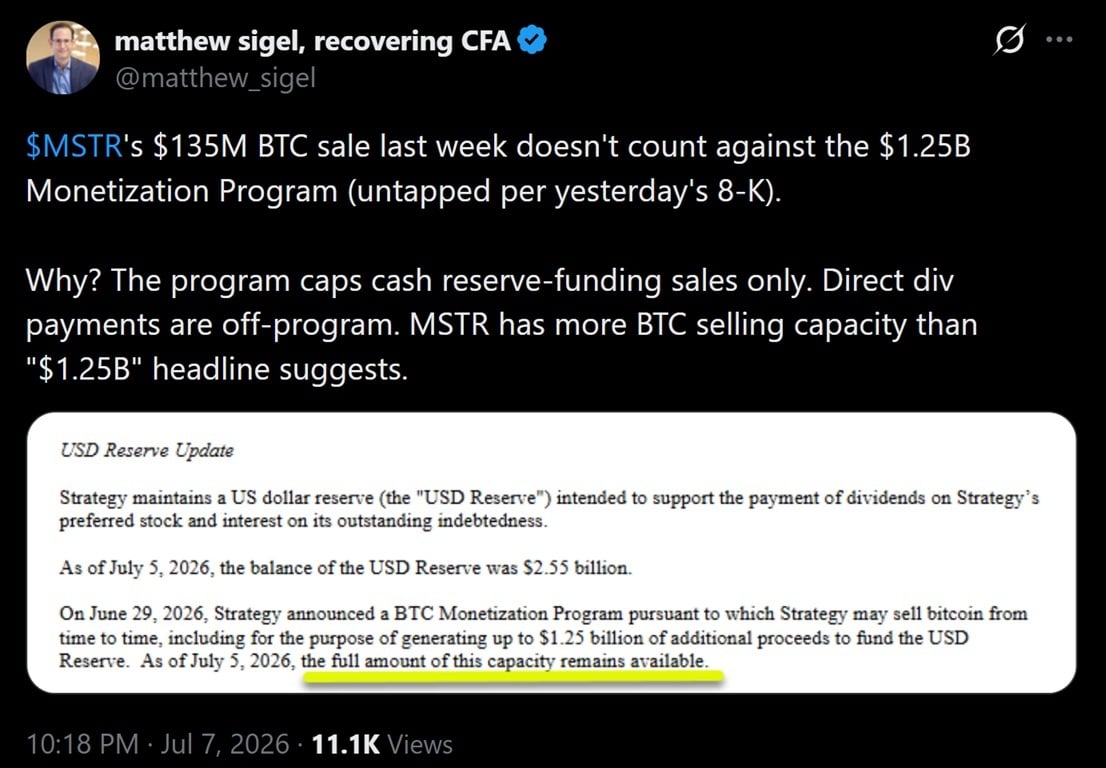
The company first sold 1,363 BTC at an average price of $59,256, then another 2,225 BTC at an average of $60,773. Proceeds went toward preferred stock distributions and replenishing the company’s USD reserve to $2.55 billion.
Sigel has been blunt about what the shift means for how investors should value the company. Speaking on Scott Melker’s podcast on Sunday, the Vaneck executive said:
“You’re buying a hedge fund that can trade five things: its own capital stack and Bitcoin. What P/E do you pay for such a hedge fund? I pay very low.”
Two Buckets of Selling Power
The BTC Monetization Program is a capital management framework Strategy’s board approved that permits but does not require the company to sell bitcoin to raise as much as $1.25 billion for its reserve, preferred dividend and interest payments, or repurchases of its digital credit securities and common stock. Sigel’s point is that last week’s sales were executed outside that program, meaning Strategy retains the entire authorization as dry powder.
Taken together, the two mechanisms give the company far more selling flexibility than many shareholders assumed it would ever use. For years, executive chairman Michael Saylor insisted the company would never sell its bitcoin, a stance he formally abandoned this year.
The recent sales trimmed Strategy’s holdings from 847,363 BTC to roughly 843,775 BTC, still far ahead of any other corporate treasury. The company faces about $1.5 billion in annual dividend obligations across its preferred stock instruments, obligations its software business alone cannot cover.
Analysts Split on the New Strategy
Not everyone views the formalized selling framework as benign, given JPMorgan analysts have noted that codifying a bitcoin sale policy introduces “avoidable two-way risk” into crypto markets. Grayscale, by contrast, argued the $216 million sale “reduces tail risk” by pre-funding roughly 17 months of dividends and easing pressure for forced selling into weakness.
In Sigel’s telling, Strategy is no longer a pure leveraged bitcoin proxy but an actively managed vehicle that trades its common stock, four preferred instruments, and its bitcoin stack against one another (a machine that can create value in both directions, but one that deserves a lower multiple than a growth company). In any case, the coming few weeks will be interesting, to say the least.